Indonesia2010
Sat 6 Mar
To Gili Trawangan; PADI Open Water lessons begin
Translated from the original Japanese journal.
Day 3 — Paradise = Gili Trawangan
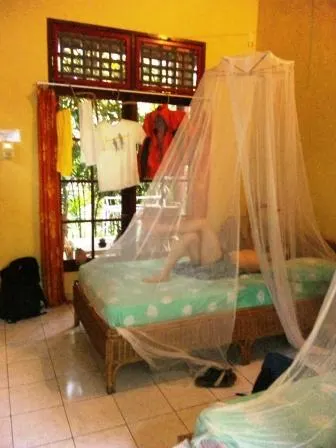
This is what our room looked like. It had a mosquito net, and a fan on the ceiling. Unlike Jakarta it wasn't very humid, and we slept soundly.
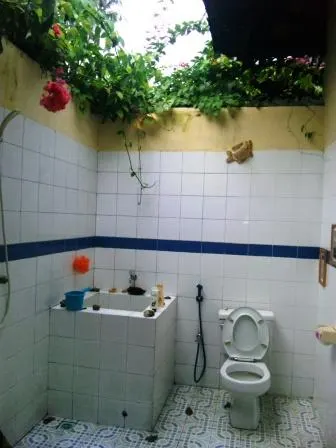
This place had a shower too. There was no ceiling; you could see the sky, very open.
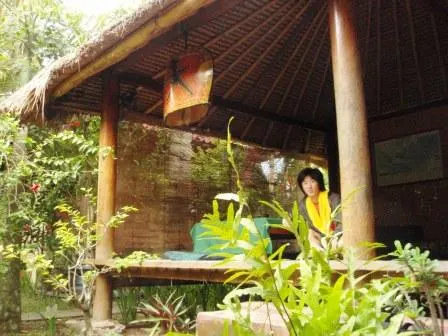
Breakfast time in a nearby annex. The so-called Lombok coffee they served looked like powder put in a cup with hot water poured straight on, but if you drink only the top it's very mild and delicious.
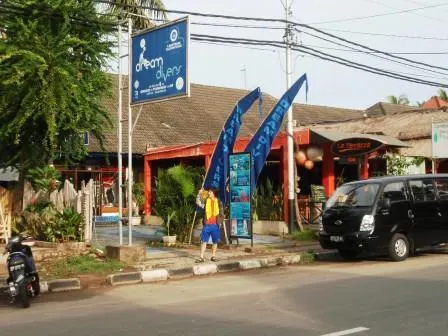
In front of the Dream Divers office in the town of Senggigi. This is the dive shop that would look after us as we worked toward our PADI Open Water Diver licence. When we said hello, we learned that the dive shop people had come to meet us at the airport yesterday. The two-hour flight delay was one reason, but we had been told to go to the hotel by taxi, so it seems the message hadn't got through properly.
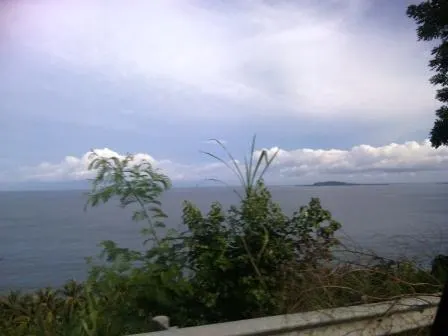
To get from Senggigi to our destination, Gili Trawangan, you first go by van to a remote port called Bangsal. Lombok's coastline is very rugged, a twisting route full of ups and downs. After driving for a while, small islands appeared offshore. There are no islands further west, so this had to be our destination, Gili Trawangan, said to be a backpacker's paradise.
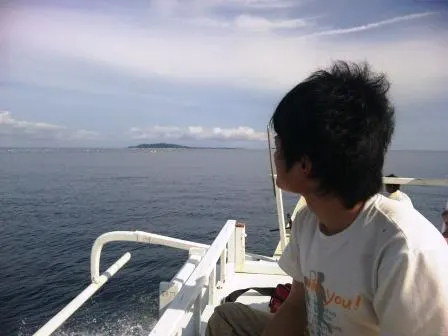
From Bangsal we switched to a small boat and went by sea to Trawangan. Just as on the map, you can see the three islands of Gili Air, Meno and Trawangan side by side. By the way, gili apparently means "small island" in the language of the Sasak people who live on Lombok. Trawangan is the largest of the three Gili islands off north-west Lombok, and rises a little in the middle. They say the Japanese army once had a lookout over the Lombok Strait on this hill, and an air-raid shelter still remains.
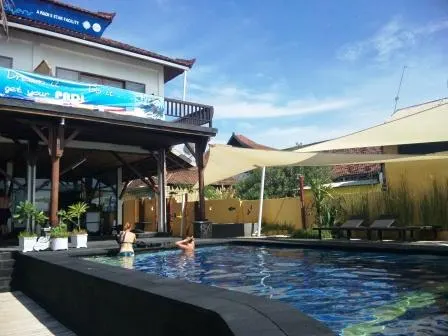
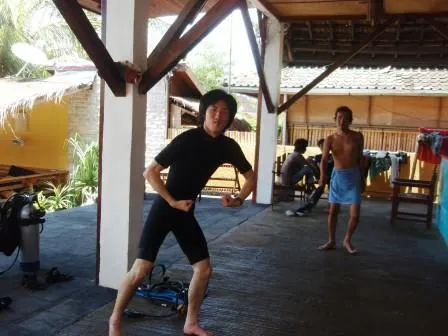
When we reached the island, the Dream Divers office was right there. After arriving, we started by looking for somewhere to stay. They recommended the bungalows attached to the office, but they were a bit pricey, so when we said we'd like somewhere a little cheaper, office staff took us to several places. Once our lodging was settled, the lessons toward our licence started straight away. First we watched a DVD for about an hour to learn the basics of diving. After that, straight into practice in the pool in front of the office. Our instructor was a slightly funky guy with tattoos, or so we thought; when we later asked his age, he was 37, which was a surprise.
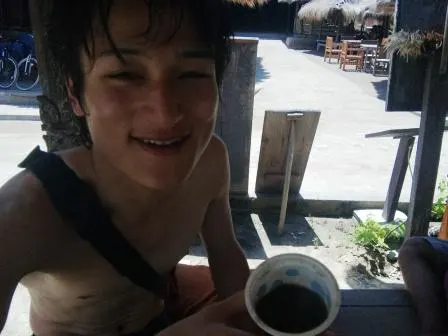
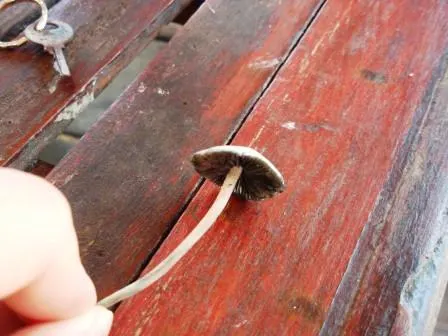
After the pool session we went for lunch. The street in front of the dive shop is the island's main street, lined with many shops. There are lots of Westerners on this island, and nearly all the restaurants are bar-style places they'd like. We didn't see anyone who looked Japanese at all. We went into a café and ordered pasta. While we waited, two boys who called themselves Roshi and Ena started talking to us. As we enjoyed some small talk, they began suggesting we try a delicious mushroom juice. "Delicious, cheap," they pushed hard, so we ordered just one glass. They pushed hard for two, but we declined. This was our biggest mistake on this island. When we paid after the meal we were stunned to be charged about 2,000 yen, not a huge amount, but it should have been about 600. We protested it was too expensive, but "Happy Drink" had been slyly written in a corner of the blackboard. We grudgingly paid, but in fact the juice we had been made to drink contained magic mushrooms, a type of drug. They have been illegal in Japan since 2002. They're known too because a famous actor once suffered poisoning symptoms from them. On top of these mushrooms, people on this island casually try to sell you marijuana. Their stock phrase is "Happa happa!" We would later learn that many tourists who carelessly got involved have been arrested, and I thought we absolutely had to be careful about this. It felt like the island's baptism, and it made me very angry, but I vowed that from now on we would never accept their offers and would be much more on guard.
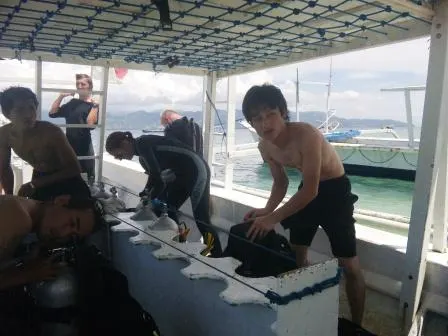
After lunch, the open-water training already. We loaded the gear onto the dive boat and set out to sea. The breeze felt great. The Open Water Diver course has four open-water dives in total, and the first two go to 12 m. Our first dive site was Bounty. On "3, 2, 1" we dived into the sea. Breathing from the regulator, we gradually descended toward the seabed. The clear, beautiful water was about 30 °C and very comfortable. It felt like we could stay down for hours. As we approached the seabed, a stunning view spread out: coral reefs and countless tropical fish. Their beauty, and how moved we were, can't be put into words. The advertising line that you'll meet far more creatures diving into the sea for 10 minutes than hiking a mountain for an hour made sense.
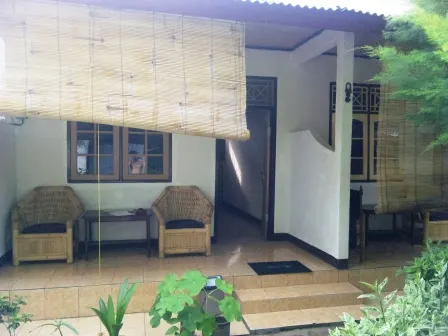
The dive at Bounty was about 12 m deep, and we were hardly tired at all. But because of the big change in pressure, our ears felt quite strange afterwards. Ooi couldn't equalise (clear his ears) properly, so he had been enduring a lot. We went back to our lodging, Dessy Bungalows, for a while. But the power seemed to be off. On this tropical island, not being able to use a fan is really tough. On top of that, we couldn't charge our phones or cameras. "They've cut the power because we chose a cheap place!" we fumed, but we later learned that on the Gilis the power supply is unstable and outages are frequent. It was clearly written in the lodging's leaflet too. Of course, restaurants and fairly upmarket hotels seem to have their own generators.
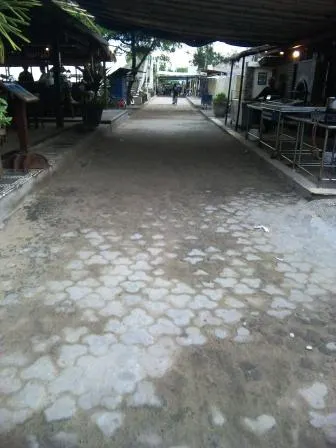
After a rest at the lodging, we went out to explore the island. It's only a little over 2 km from north to south, so it should be perfect for a walk. This is the island's main street, lined with many bar-style restaurants.
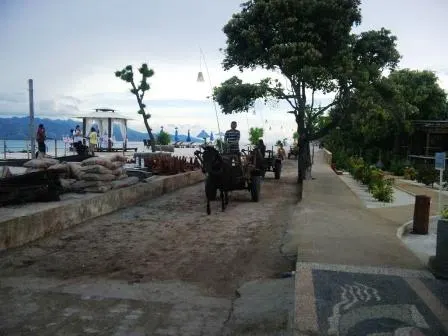
We walked south along the main street. Most of the road is unpaved. The island has a rule that no motorised vehicles are allowed, so there are no cars or motorbikes. The main means of transport are horse carts (cidomo) and bicycles.
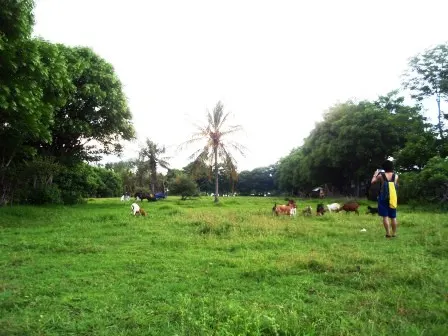
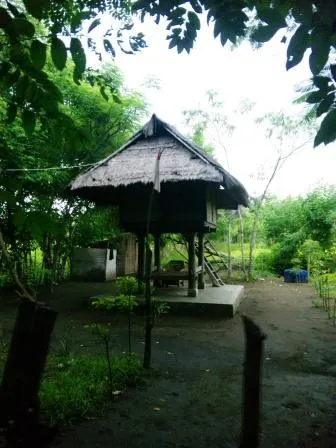
Going inland, there were local people's houses and empty plots, with lots of chickens and goats roaming free. Watching the chickens, you really start to think they aren't very bright. They roam free, but they aren't pets; they must be for meat or eggs, yet the chickens seem to think about nothing all day but pecking the ground for food. If one of their friends disappears one day, they don't care. Even if a friend is slaughtered in front of them, there's no particular fuss. If there's food in front of the house, they don't run away either.
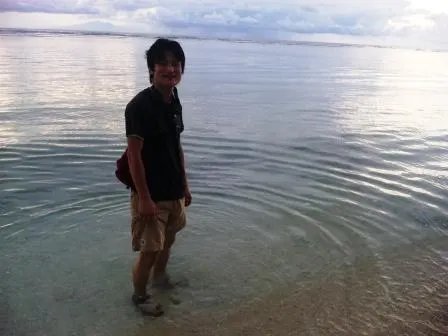
We were walking inland but lost track of where we were, so we walked on at random and came out on the coast near the southern tip of the island. We followed the coast north for a while and reached the west side of the island. While the east side bustles with shops, the west side has hardly any shops, or even houses. A calm shore with almost no waves, and in the distance you can see Bali too.
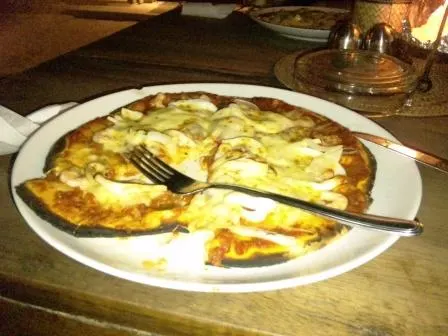
The island was bigger than we expected and we got tired. Walking was a bother, so we hopped on a passing horse cart. Back on the east side of the island, we went to a bar restaurant. Prices on this island are a bit high: a pizza is about 400 yen. We ordered a seafood pizza, and this place's pizza is the real thing, baked in a stone oven after you order. Being an island nation, all the seafood was delicious and satisfying. Though pizza doesn't feel Indonesian at all.
To the next day