Day 8
Driving western Canada
Translated from the original Japanese journal.
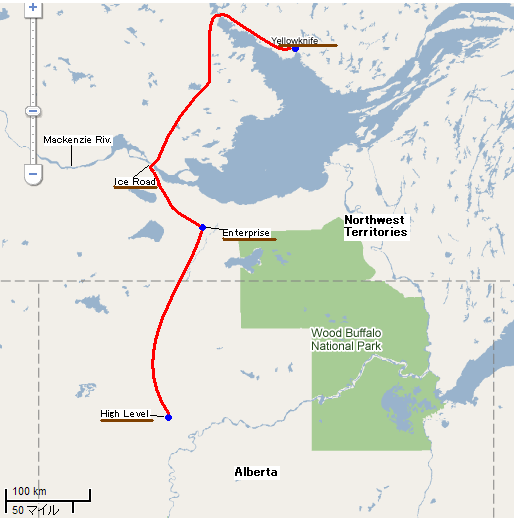
□ Day 8 (19 Feb) High Level → Yellowknife
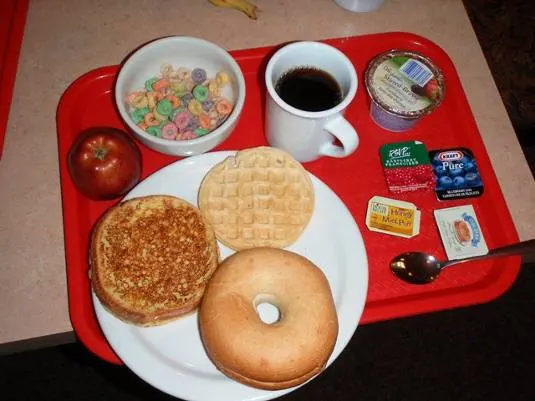
This motel offers a free breakfast. The self-service spread had bread, cereal, muffins, yoghurt, apples, waffles, French toast, and drinks like coffee and milk. We gratefully ate all sorts of things. And it seems we ate too much.
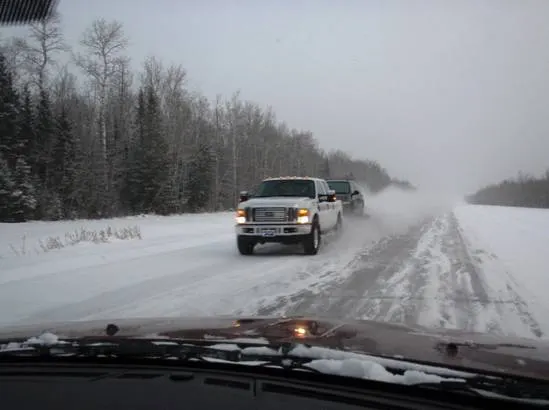
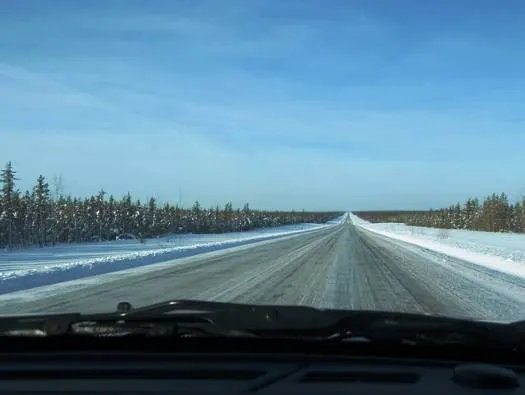
Today's destination was Yellowknife. High Level is at 58° north; Yellowknife is at 62°. The border between Alberta and the Northwest Territories is at 60°. For reference, Cape Soya, the northernmost point of Japan, is at 45°. The snow seemed to have stopped during the night, but the road was white and the centre line was completely invisible. A little worried, we set off for Yellowknife. But there was no sense of the tyres slipping at all. There wasn't much traffic, but when an oncoming car passed, the snow on the road flew up and was blown to the shoulder, clearing the road naturally. When a big vehicle like a truck came the other way, the huge amount of snow it kicked up turned our view white and we couldn't see anything for a moment, which was quite frightening. Around here the scenery hardly changes no matter how far you go; you just keep going along a single wide white road through the forest.
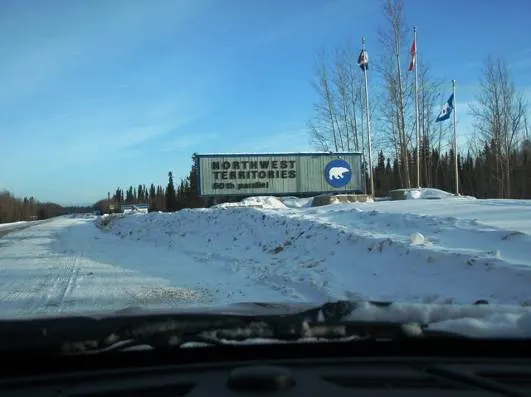
Just before noon we finally reached 60° north, the border of the Northwest Territories (NWT). There's a big sign marking the border. From here we drove the Mackenzie Highway, NWT Highway 1. In Enterprise, the first small town we found after entering the Northwest Territories, we refuelled and bought lunch. There didn't seem to be any restaurants, just a small petrol station and a shop.
Highway 1 was snow-covered in places, but it wasn't that bad a road. Coniferous forest stretched along both sides the whole way. At the junction of Highway 1 and Highway 3 (the Yellowknife Highway) we took Highway 3, and after a while we finally reached the ice road across the Mackenzie River. There is still no bridge across this river; in summer cars cross by ferry, and in winter they drive on the ice. When the ice is melting and when it is starting to form, traffic is cut off. A sign before the river said that vehicles of up to 64,000 kg could currently cross.
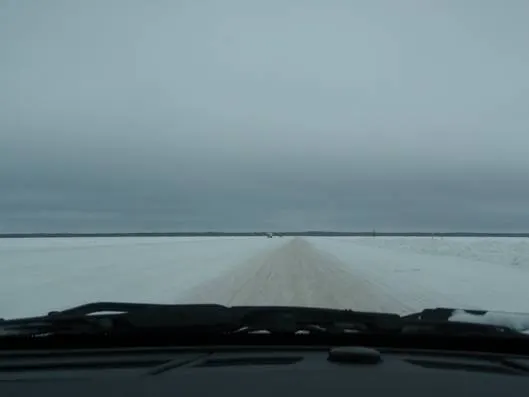
Out on the ice road, a pure white world spread out with the Mackenzie River on the left and Great Slave Lake on the left. Only the ice surface where cars pass was tinted a pale earth colour. Great Slave Lake, the tenth largest lake in the world, looked as if it spread beyond the horizon. And for some reason there were lots of ravens. They clustered around the car.
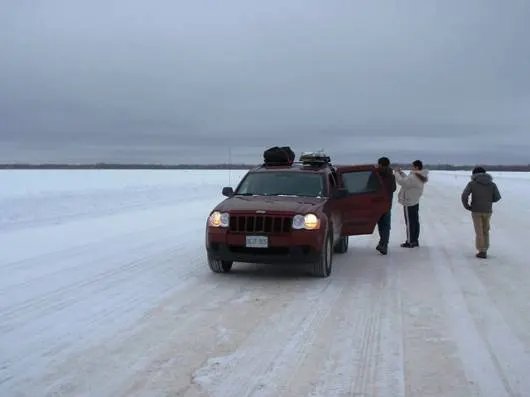
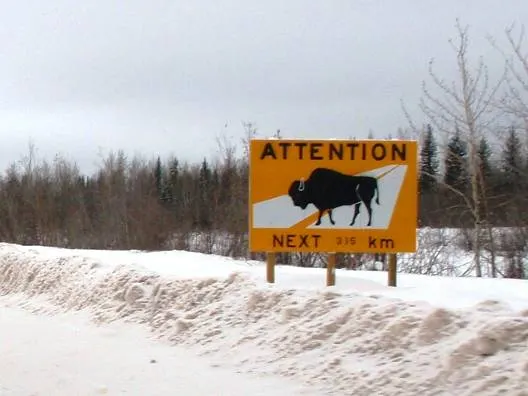
From here to Yellowknife is about 300 km. In between there isn't a single settlement along the road. There's no mobile signal either, so if something happened it would be very troublesome. And this area seems to be a bison warning zone. There were lots of bison warning signs. The trees beside the road were getting shorter, and there were occasional open views. The temperature at midday was −21 °C.
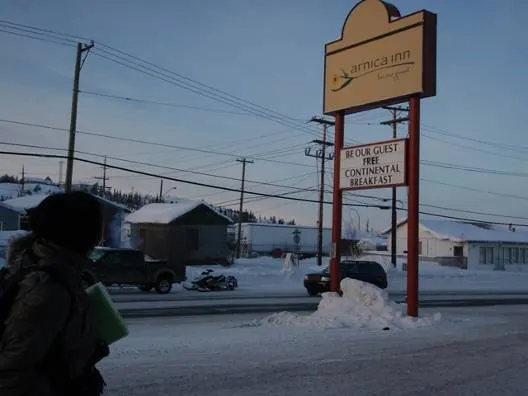
Buildings suddenly appeared out of the untamed wilderness. Then road signs abruptly multiplied and we plunged into the centre of Yellowknife. It all happened in an instant. It really felt like a city. To think high-rise buildings stand in a place this far north... At −20 °C the city was full of life, with many people walking about. We checked in to a motel called "Arnica Inn", a little past the centre. It had recently been renovated, and the rooms were clean and comfortable. And this place was cheap too. We couldn't completely understand the English conversation with the receptionist, but we got to stay for less than the price we had looked up.
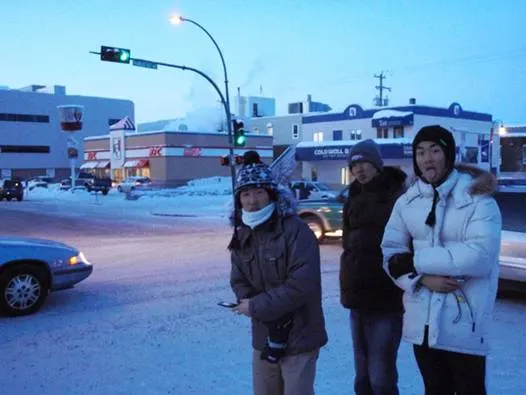
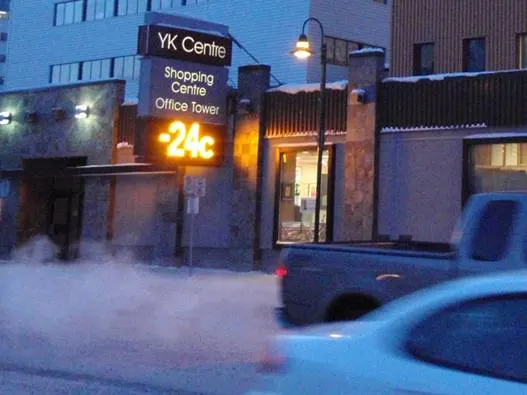
We walked out for dinner. It really was cold. You could feel the inside of your nostrils freezing. The temperature on the city's electronic sign showed −24 °C. Cold enough that even mobile phone screens went strange. It's amazing that so many people were still walking about.
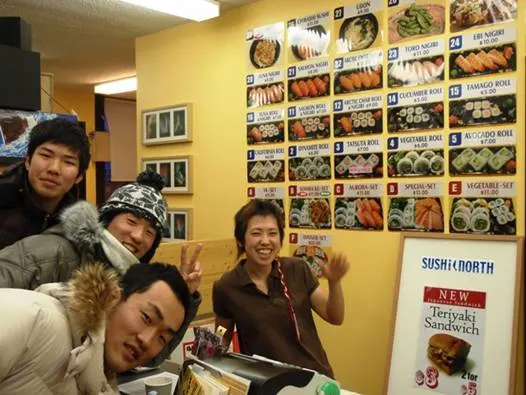
We ended up at a sushi restaurant called "Sushi North". The staff were all Japanese. We chatted with them about our trip so far and ordered a nigiri set. What they especially recommended was Arctic char nigiri. Apparently you can only eat it here. It had a texture like toro, melting in an instant in your mouth and spreading a rich flavour. There was also salmon, tuna and prawn nigiri, plus a Dynamite roll and a California roll. We all left very satisfied, and the temperature had dropped to −26 °C.
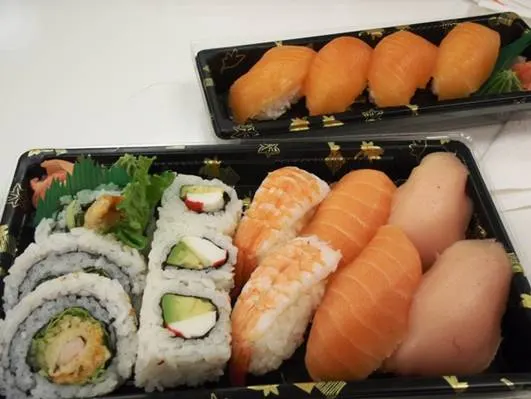
Back at the motel, we relaxed, and late at night we went outside and looked up at the sky. Some cloud had spread. The city lights got in the way too, and it looked like we wouldn't see the aurora today. But after a while we went out again. Looking from a place away from the city lights, we could tell there was a faint aurora. We would see it properly tomorrow.